
Floral foam is quick, cheap and almost foolproof, so it is easy to see why it took over flower arranging for decades. But more florists and home arrangers are now asking whether it is worth the environmental cost, and whether older tools such as the flower frog deserve a comeback.
This article compares the two honestly: how each works, what the concerns about foam actually are, what we do and do not know, and what else you can use. If you decide to give a frog a try, our free Flower Frog Size Calculator will help you pick the right size for your vase.
What is floral foam?
Floral foam is a lightweight, spongy block, usually green, that you soak in water and then push stems into. It holds the stems at whatever angle you choose and keeps them supplied with water, which made it ideal for tall, rounded arrangements and for flowers that have to travel.
It was introduced in 1954 and spread quickly through the floristry trade. Over the following decades it gradually replaced the flower frogs, and the wire and moss techniques, that earlier generations of arrangers used.
What is a flower frog?
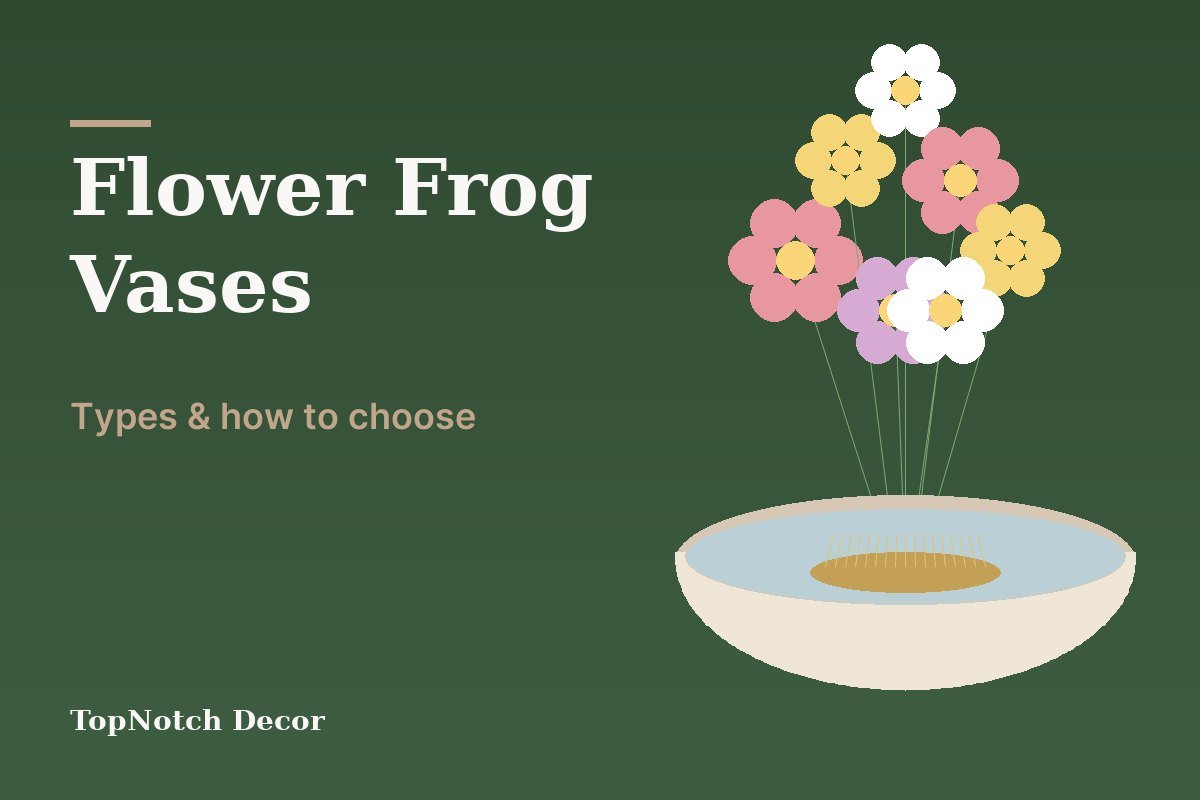
A flower frog is a small, reusable holder that sits in the bottom of a container. Stems are pushed onto upright pins, slotted through holes or gripped in a wire cage, so they stay where you put them. Flower frogs date back to 14th-century Japan, where they developed alongside ikebana, and they were hugely popular in the 1920s. If you have not met one before, start with Flower Frog Vases: What They Are, Types & How to Choose.
The environmental concerns about floral foam
Most of the criticism of foam comes down to a few points:
- It is single-use. Foam holds the holes left by stems, so it is generally used once and thrown away.
- It does not biodegrade. It is a plastic material, so it does not break down the way organic matter does.
- It can break into tiny fragments. Critics, including some florists and environmental groups, are concerned that as it crumbles it can shed microplastics, which can end up in drains and waterways.
- Handling. The dry foam produces dust, and some people prefer to avoid breathing it in.
These concerns are widely discussed, and a growing number of florists have started to move away from foam as a result.
What we do not know
It is worth being honest here. To our knowledge there is no published life-cycle study that directly compares floral foam with a reusable frog over the whole of their lives, covering the materials, manufacturing, shipping, use and disposal. A frog is made of metal, glass or ceramic, so it has its own manufacturing footprint, and it only beats foam on that measure if you actually use it many times. What most people can agree on is the simple point: a tool you use for years creates far less waste than a block you throw away after one arrangement.
Flower frog vs floral foam: pros and cons
| Flower frog | Floral foam | |
|---|---|---|
| Reusable | Yes, for years | Usually single-use |
| Cost over time | Higher upfront, then free | Low per block, but recurring |
| Skill needed | A little practice | Very easy |
| Stem angles | Flexible with pin frogs | Flexible, but holes stay in the foam |
| Water supply | Stems sit in open water | Foam holds water against the stem |
| Container | Best in wide, shallow bowls | Works in almost any shape |
| Weight for transport | Frog is heavy; water can spill | Lighter and spill-resistant |
| Waste | Little | Non-biodegradable block |
Other foam alternatives
If you do not have a frog, you have other choices:
- Chicken wire. Crumpled into a ball and set in the vase, it makes a flexible cage that holds stems at different heights. It can be reused many times.
- Moss. Damp moss packed in a container supports lighter stems and looks natural, though it is less structural than wire.
- Pebbles, glass stones or marbles. Layered in the base of a clear vase, these steady stems and hide the mechanics.
- Twigs and branches. A grid of twigs, or a crisscross of stems wedged across the rim, forms a natural support.
- Tape grids. A grid of clear floral tape across the mouth of a vase is a simple, inexpensive way to keep stems upright.
Making the switch from foam to a frog
If you are used to foam, a frog feels different at first. Here is how to make the change smoothly:
- Start low and wide. Practice in a shallow bowl, where a frog is at its best, before attempting something taller.
- Use fewer, stronger stems. A frog rewards deliberate placement. Aim for fewer stems with clear structure rather than packing the bowl.
- Anchor the frog. A few small pieces of floral putty on a dry base stop it sliding, which is the most common frustration for beginners.
- Keep the water topped up. Unlike foam, which holds a reserve, a frog sits in open water. Check it daily.
- Size it correctly. A frog about one third to one half of the vase’s inside base is a good guide, and the calculator will give you the exact figure.
When foam still makes sense
A balanced view means admitting where foam is genuinely convenient. It is lightweight, it keeps stems supplied with water while you carry a finished piece across town, and it can hold a tall, rounded shape that is difficult to build in open water. Some people also have limited hand strength or time, and the ease of foam matters to them. If you do choose foam, you can reduce the impact by using only as much as you need, reusing a block for as many arrangements as it will bear, and disposing of it carefully rather than rinsing fragments down the drain.
Which should you choose?
If you arrange flowers often, especially low bowls and loose, natural designs, a frog is a good long-term investment and is easy to master. If you need a large, tall, spherical arrangement, or you are creating something to transport, you may find wire, moss or a combination more practical. For small, simple arrangements at home, a frog or a few pebbles is often the easiest and most attractive solution.
Ready to try one? Our step-by-step guide on how to use a flower frog will get you started, and the Flower Frog Size Guide shows what size to buy.
Frequently Asked Questions
Is floral foam bad for the environment?
It is a single-use plastic material that does not biodegrade and can shed small fragments as it breaks down, which is why many florists are moving away from it. There is no published life-cycle study that compares it directly with reusable options, so the case rests on the general principle that reusable tools create less waste.
Can a flower frog replace floral foam?
For many arrangements, yes, especially low or shallow designs. For very tall, large or rounded arrangements and for transport, wire, moss or combinations may be more practical.
Are flower frogs more expensive than foam?
A frog costs more at the start, but you can use it again and again, so it is often cheaper over time than buying foam for every arrangement.
What can I use instead of floral foam?
You can use a flower frog, chicken wire, damp moss, pebbles or glass stones, a grid of twigs, or a grid of clear floral tape across the vase.