
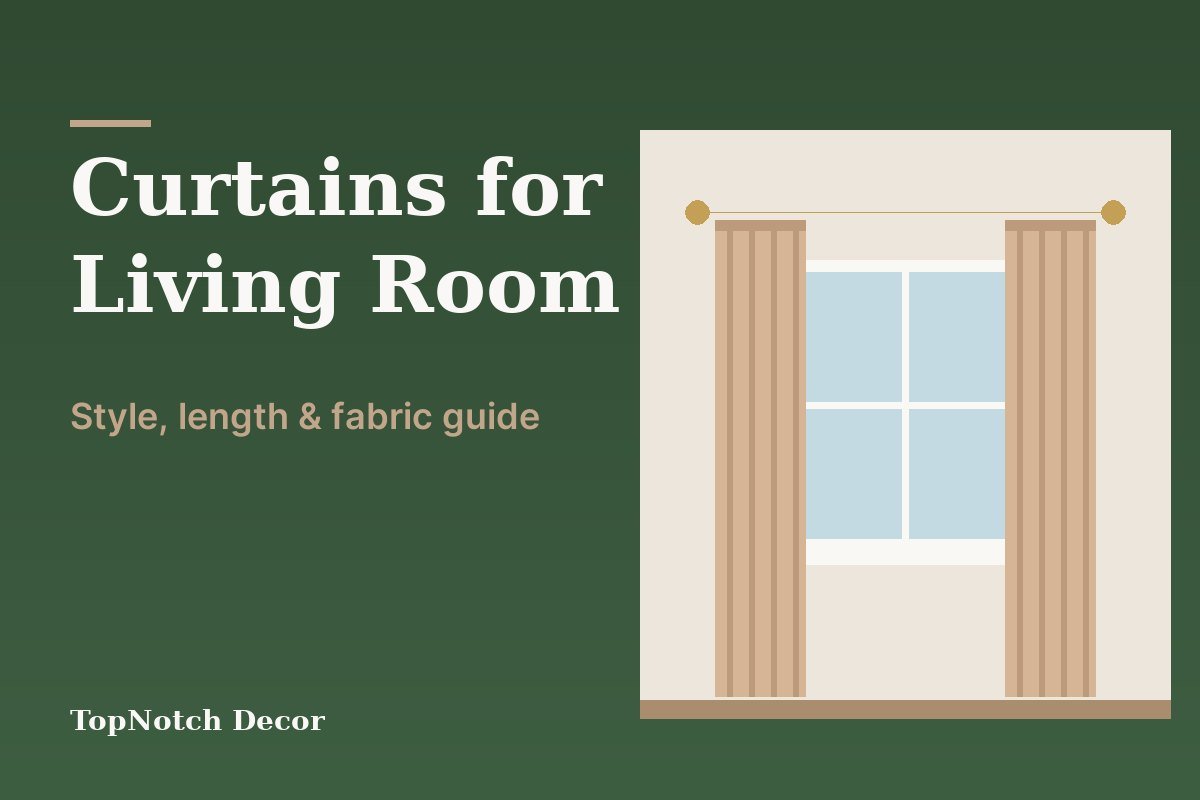
Curtains do more work in a living room than almost any other soft furnishing. They frame the windows, soften echoey walls, control glare for the TV and give the whole room a finished, layered look. They are also easy to get wrong: panels that stop short of the floor, a rod that is the same width as the window, or fabric so thin that the room looks bare.
This guide walks you through choosing curtains for your living room, step by step: the style, the fabric and color, the length, the width and where to hang the rod. If you would rather skip straight to numbers, our free Curtain Size Calculator takes your window, your ceiling height and the look you want, and returns the rod length, panel count and curtain length.
Start with what the curtains need to do
Before you look at a single fabric swatch, decide what job the curtains have. A living room usually asks for a mix of these:
- Soften the room. Hard surfaces such as floors, glass and TV screens bounce sound around. Fabric absorbs some of it, so a living room with lined curtains tends to feel calmer.
- Control light. Do you want to cut glare on the TV, keep an afternoon sun from fading the sofa, or simply let in as much daylight as possible?
- Give privacy. A street-facing window may need a sheer layer by day and a heavier one at night.
- Add height and color. Curtains are the largest area of fabric most people hang in a room, so they carry a lot of the look.
- Insulate. A lined, heavier curtain helps reduce drafts and the feeling of cold near a large window.
Your answers decide the fabric and whether you need one layer or two.
Pick a curtain style
Most living rooms use one of these four styles:
| Style | Look | Best for |
|---|---|---|
| Rod pocket | Gathered, casual, a little ruffled at the top | Lightweight and sheer fabrics, simple rooms |
| Grommet | Modern, with deep, even folds and metal rings | Contemporary rooms; panels that you open and close often |
| Back tab or tab top | Casual, with a flat front and hidden loops | Panels that stay in one place |
| Pinch pleat | Tailored, with fitted pleats | Formal living rooms and heavier fabrics |
If you are unsure, a grommet or a simple tab top panel is the easiest to hang and the easiest to live with. Pinch pleats look the most expensive, but they usually need more fabric and more care.
Choose a fabric
The fabric decides how the curtain hangs, how much light it blocks and how it looks at different times of day.
- Sheer (voile, linen-look polyester). Lets light through and gives some daytime privacy. Airy, but it does little for glare or insulation.
- Light-filtering. A medium-weight fabric that softens sunlight without darkening the room. A good all-round choice for most living rooms.
- Blackout. Blocks nearly all light. Great for a media room, less necessary in a room used mostly in the daytime.
- Velvet and other heavy fabrics. Rich, drapes in deep folds and insulates well. They need a strong rod and are best in larger rooms.
- Linen and cotton. Natural, textured and relaxed. Real linen wrinkles and can shrink if washed, so check the care label.
A tip many people overlook: hold the fabric up to a window before you buy. A white that looks bright in the shop can look gray in your own light.
Color and pattern
Because curtains are large, a small change in color goes a long way.
- Match the wall, a little lighter or darker. The curtains almost disappear, which makes the ceiling feel higher and the room calmer.
- Use a color from the room. Pick up the shade of a rug, a cushion or a piece of art, so that the curtains tie the scheme together.
- Go for contrast. A deep green or navy against light walls makes the windows a feature.
- Be careful with large patterns. A bold print looks great, but it needs a quiet sofa and rug to balance it. Stripes can add height when they run vertically.
If you are not sure, a warm white, a soft greige or a muted natural tone works with nearly everything and is easy to refresh with new cushions.
Get the length right
Length is the most visible mistake in a living room. Short curtains read as an afterthought. In most living rooms the best choice is floor length, hung so the hem stops about half an inch above the floor, or just kisses it. Here are the common options:
| Length | Where the hem sits | Best for |
|---|---|---|
| Sill | Just below the window sill | Small windows, or a radiator or a desk below |
| Apron | About 4–6 in below the sill | Casual rooms where floor length is not practical |
| Floor | About ½ in above the floor | Most living rooms; the standard, clean look |
| Puddle | 2–4 in of fabric resting on the floor | Formal, dramatic rooms; harder to keep clean |
For a full explanation, with measurements and examples, read How Long Should Curtains Be?
Get the width right
The second most common mistake is panels that are too narrow. When curtains are closed they should look full, with soft folds, not flat like a sheet. As a rule of thumb, the total width of your panels should be 2 to 2.5 times the length of the rod. Thin fabrics need more fullness than heavy ones.
The rod should also be wider than the window, usually by 4 to 8 inches on each side, so the open curtains rest on the wall and do not cover the glass. That gives you more light and makes the window look wider. A deeper look at the numbers is in How Wide Should Curtains Be?
Hang the rod high
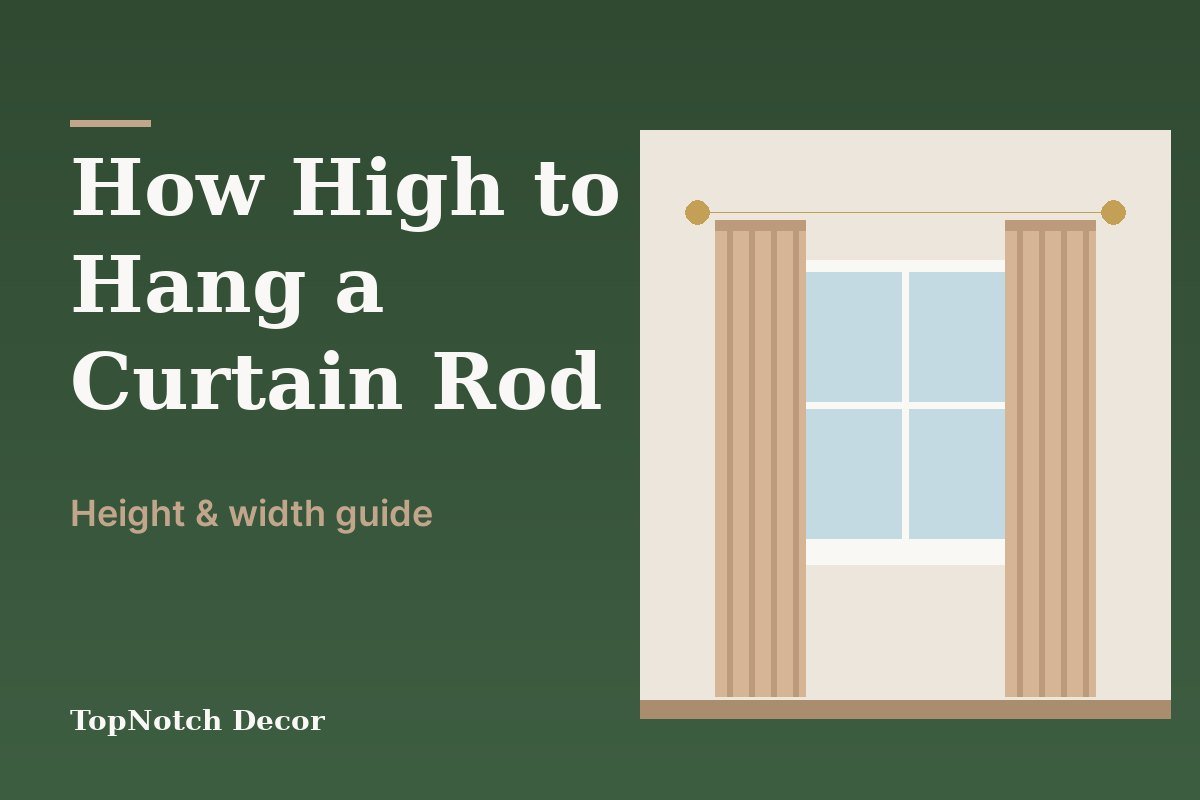
Hang the rod higher than the window frame. A mounting point 4 to 6 inches above the frame, or closer to the ceiling in a room with a low one, draws the eye up and makes the ceiling feel taller. See How High to Hang a Curtain Rod for the details, including what to do with crown molding and short walls.
Curtain ideas by living room style
- Modern and minimal. Plain panels in a solid, muted color with grommets or a simple back tab heading, on a slim black or brass rod. Keep the folds even and the hardware quiet.
- Scandinavian and light. Natural linen or linen-look fabric in white, oatmeal or pale gray. Light-filtering weight keeps the room bright, and a thin rod keeps it airy.
- Traditional. Pinch pleat panels in a heavier fabric, hung from a rod with decorative finials and held back with tiebacks. Floor length, or a small puddle in a formal room.
- Cozy and warm. Velvet or a textured weave in a deep tone such as forest green, rust or navy, lined for extra weight, with panels that run the full width of the wall.
- Boho and relaxed. Cotton or gauze with a soft pattern or a fringed edge on a wooden rod with rings, hung a little fuller than usual.
Whichever look you choose, repeat one color or texture from the curtains elsewhere in the room, for example in a throw or a cushion, so the window does not feel like a separate project.
Layer for more control
Many living rooms look best with two layers on a double rod, or with a sheer panel behind a heavier one:
- Sheer inside, heavy outside. The sheers stay closed by day for privacy and soft light; the heavy panels close at night.
- Curtains plus shades. A roller or Roman shade does the daily light control and the curtains handle the style.
- Blackout lining. Lining a decorative fabric is a cheaper way to get blackout performance without losing the look.
Curtains for common living room situations
- One wide window. Hang a single rod about 12 inches wider than the window (6 inches each side) and use two panels, one on each side.
- Two windows close together. Treat them as one wide window, with a single rod that spans both and a pair of panels at the outer edges.
- A sliding glass door. Choose a rod that is wide enough that the panels clear the glass when open. Use a heavier fabric if you need insulation.
- A bay window. A curved rod or three separate rods follow the shape; keep the fabric light enough not to crowd the corners.
- A low ceiling. Hang the rod close to the ceiling, use vertical stripes or a solid color, and keep the fabric light.
- A high ceiling. Hang the rod about a third of the way up from the top of the window to the ceiling, and use floor length panels so the curtain still touches the floor.
How to measure your living room windows
- Measure the window from one outside edge of the frame to the other, then from the top of the frame to the sill.
- Measure the sill height from the floor to the bottom of the window, which affects the floor length.
- Measure the ceiling height if you plan to hang the rod high.
- Decide the rod position. A common choice is 4 inches above the frame, with the rod extending 6 inches past each side.
- Enter these numbers in the Curtain Size Calculator to get the rod length, number of panels and curtain length.
Buying ready-made or making your own
Ready-made panels are sold in set widths and lengths, most commonly about 50 inches wide and 63, 84, 95, 96, 108 or 120 inches long. They are the cheapest and quickest route. The calculator rounds your needs to the nearest ready-made length and tells you how far off it is, so you know whether to hem, buy longer or adjust the rod height.
Custom or homemade curtains let you pick the exact length and width. If you sew your own, add about 4 inches at the bottom for the hem, about 4 inches at the top for the heading and 4 inches of side hem, and tick the “making my own” option in the calculator to see the cut size.
Common mistakes to avoid
- Hanging the rod at the window frame. It makes the window and the ceiling look smaller.
- Short curtains. Panels that stop midway between the sill and the floor look unfinished.
- Too little fullness. A pair of flat panels, even in a nice fabric, looks cheap.
- A rod the same width as the window. The curtains cover the glass when open and block light.
- Ignoring the hardware. A thin rod sags under heavy fabric. Match the rod, brackets and rings to the weight of the curtains.
- Forgetting a center support. Rods wider than about 48 to 60 inches usually need a bracket in the middle.
Finishing touches
Good hardware, a steamer for the creases and a tieback or holdback for the open position finish the job. If you are updating the rest of the room, a good rug, a matching accent pillow and a few accessories bring the scheme together. Browse our decor guides for ideas.
Frequently Asked Questions
What length should curtains be in a living room?
For most living rooms, floor length is the best choice, with the hem about half an inch above the floor. Sill length works for small windows or where furniture sits below the window.
How wide should living room curtains be?
The panels together should measure about 2 to 2.5 times the length of the rod, so they look full when closed. The rod itself should extend about 4 to 8 inches beyond each side of the window.
How high should I hang curtains in a living room?
Hang the rod about 4 to 6 inches above the window frame, or closer to the ceiling if you want the room to look taller.
Should living room curtains match the walls?
They do not have to. Curtains in a color close to the wall make the room feel calmer, while a contrasting color turns the window into a feature. Both work.
Do I need two layers of curtains?
No, but two layers give more control. A sheer layer gives daytime privacy and soft light, and a heavier layer closes at night.